
MDM4U Grade 12 Data Management Math Course Description
 This course broadens students’ understanding of mathematics as it relates to managing data. Students will apply methods for organizing and analysing large amounts of information; solve problems involving probability and statistics; and carry out a culminating investigation that integrates statistical concepts and skills. Students will also refine their use of the mathematical processes necessary for success in senior mathematics. Students planning to enter university programs in business, the social sciences, and the humanities will find this course of particular interest.
Prerequisite: Functions, Grade 11, University Preparation, or Functions and Applications, Grade 11, University/College Preparation
I often receive emails from teachers across Ontario looking for some resources for the Grade 12 MDM4U Data Management course. I always loved teaching this course, but haven’t had the opportunity in the past few years. Take what you’d like from here. If it helps you along the way, I’d love to hear from you in the comments section at the bottom of the page.
It should also be noted that I have undergone a complete transformation in how I believe mathematics should be taught and learned and thus how I delivered math lessons a decade ago is completely different than how I teach now. Learn more about transforming your math lessons from rushing to procedures to problem based math lessons here.
3 Act Math Tasks
MDM4U Grade 12 Data Management Real World Math Problems
 Access 3 Act Math Tasks related to the MDM4U Grade 12 Data Management Math Course.
Access Grade 12 Data Management course material related to Counting and Probability, Data Management and Statistical Analysis.
There may also be some 3 act math style problem based lessons and units on the Make Math Moments site.
MDM4U Grade 12 Data Management Culminating Projects
Statistics and Probability Independent Projects
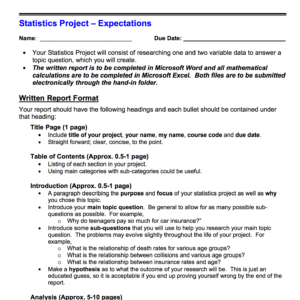 Access the MDM4U Grade 12 Data Management Culminating Project Expectations, Rubric, Proposal and Exemplars for both the One- and Two-Variable Statistics and Probability Culminating Projects.
MDM4U – Mathematics of Data Management – Grade 12 – Worksheets
McGraw-Hill Ryerson – Digital Textbook
| RESOURCES | DESCRIPTION |
| Electronic Textbook & Full Solutions Manual |
McGraw-Hill Ryerson Textbook: Mathematics of Data Management in PDF format. Also included is the full solution manual for even numbered problems.Download Adobe Reader to view files. All files are numbered according to the order of the textbook, not our course! |
| Introduction to Excel | Powerpoint presentation which teaches the user, step-by-step, how to use Microsoft Excel to manage and manipulate data effectively. |
| Introduction to Fathom | Powerpoint presentation which teaches the user, step-by-step, how to use Fathom to manage and manipulate data effectively. |
| Importing Data Into Fathom | Word document which describes how to import data into Fathom and other data management software packages. |
MDM4U – Unit 1 – Statistics of One Variable
| Sec. 1.1 (2.1) – Data Analysis with Graphs (Part 1) | Page 101-103 #2, 7, 13 |
| Sec. 1.1 (2.1) – Data Analysis with Graphs (Part 2) | Page 101-103 #1, 3(ab), 5, 9, 11 |
| Sec. 1.2 (2.3) – Sampling Techniques | Page 117-118 #1-9 |
| Sec. 1.3 (2.4) – Bias (Learn Independently) | Page 123-124 #1-6, 8 |
| Sec. 1.4 (2.5) – Measures of Central Tendency | Page 133-135 #1-10, 12, 14 |
| Sec. 1.5 (2.6) – Measures of Spread (Part 1) | Page 148-150 #1, 6a, 10 |
| Sec. 1.5 (2.6) – Measures of Spread (Part 2) | Page 148-150 #2-5, 6bc, 9, 11-14 |
MDM4U – Unit 2 – Statistics of Two Variables
| Sec. 2.1 (3.1) – Scatter Plots and Linear Correlation | Page 168-170 #1-3,5,6,9,10 |
| Sec. 2.2 (3.2) – Linear Regression | Page 180-183 #1,2,5-7,14 |
| Sec. 2.3 (3.4) – Cause and Effect | Page 199-201 #1-5, 8, 11, 14 |
| Page 209-211 #1-5,8 |
MDM4U – Unit 3 – Organized Counting
| Sec. 3.1 (4.1) – Organized Counting | Page 229 #1-20 |
| Sec. 3.2 (4.2) – Factorial Notation | Sec. 3.2 Handout |
| Sec. 3.3 (4.2) – Counting Permutations | Page 239 #1-4, 6ab, 7, 9-16, 19, 22 |
| Sec. 3.4 (4.3) – Permutations with Some Identical Elements (Learn Independently) | Page 245 #2-5, 7-9, 12, 13 |
| Sec. 3.5 (4.4 & 4.5) – Pascal’s Triangle | Page 251 #2-4 & Page 256 #1-11 |
MDM4U – Unit 4 – Combinations
| Sec. 4.1 (5.1) – Counting with Set Theory and Venn Diagrams | Page 170-172 #1-9 |
| Sec. 4.2 (5.2) – Combinations | Page 179-181 #1-9, 11-15 |
| Sec. 4.3 (5.3) – Problem Solving with Combinations | Page 286-287 #1-13 |
| Sec. 4.4 (5.4) – Relating Pascal’s Triangle to Combinations | Page 193 #1 and 4.4.1 & 4.4.2 Worksheets |
MDM4U – Unit 5 – Probability
| Sec. 5.1 (6.1) – Introduction to Probability (Part 1) | Page 312-313 #1, 4, 5, 6, 11 |
| Sec. 5.1 (6.1) – Introduction to Probability (Part 2) | Page 312-313 #2, 3, 7, 10 |
| Sec. 5.2 (6.2) – Odds | Page 318-319 #1-6, 9-12 |
| Sec. 5.3 (6.3) – Problem Solving Using Counting Techniques | Page 324-326 #1-11 |
| Sec. 5.4 (6.4) – Dependent and Independent Events | Page 334-335 #1-10, 1 |
| Sec. 5.5 (6.5) – Mutually Exclusive Events (Learn Independently) | Page 340-343 #1-8, 11, 13 |
MDM4U – Unit 6 – Discrete Probability Distributions
| Sec. 6.1 (7.1) – Probability Distributions | Page 374-376 #1-13 |
| Sec. 6.2 (7.2) – Binomial Distribution | Page 385-387 #1, 2a, 3, 5, 6bc, 7, 8ab, 10, 11 |
| Page 394-396 #1-12 | |
| Sec. 6.4 (7.4) – Hypergeometric Distribution | Page 404-405 #1, 2a, 3, 7-12 |
MDM4U – Unit 7 – The Normal Distribution
| Sec. 7.1.1 (8.1) – Continuous Probability Distributions | Page 419-421 #1-4, 6 |
| Sec. 7.1.2 (8.1) – Continuous Probability Distributions (Cont…) | Page 420-421 #7,9 & 7.1.2 Worksheet |
| Sec. 7.2 (8.2) – Properties of the Normal Distribution | Page 430-431 #1-10 |
| Sec. 7.3 (8.3) – Normal Sampling and Modelling | Page 439-441 #1-3, 8-10 |
| Page 449-450 #1-7 |
MDM4U Grade 12 Mathematics of Data Management
Strands and Overall Expectations
Counting and Probability
- CP1 – solve problems involving the probability of an event or a combination of events for discrete sample spaces;
- CP2 – solve problems involving the application of permutations and combinations to determine the probability of an event.
Probability Distributions
- PD1 – demonstrate an understanding of discrete probability distributions, represent them numerically, graphically, and algebraically, determine expected values, and solve related problems from a variety of applications;
- PD2 – demonstrate an understanding of continuous probability distributions, make connections to discrete probability distributions, determine standard deviations, describe key features of the normal distribution, and solve related problems from a variety of applications.
Organization of Data For Analysis
- DA1 – demonstrate an understanding of the role of data in statistical studies and the variability inherent in data, and distinguish different types of data;
- DA2 – describe the characteristics of a good sample, some sampling techniques, and principles of primary data collection, and collect and organize data to solve a problem.
Statistical Analysis
- SA1 – analyse, interpret, and draw conclusions from one-variable data using numerical and graphical summaries;
- SA2 – analyse, interpret, and draw conclusions from two-variable data using numerical, graphical, and algebraic summaries;
- SA3 – demonstrate an understanding of the applications of data management used by the media and the advertising industry and in various occupations.
Culminating Data Management Investigation
- CI1 – design and carry out a culminating investigation* that requires the integration and application of the knowledge and skills related to the expectations of this course;
- CI2 – communicate the findings of a culminating investigation and provide constructive critiques of the investigations of others.