Category: MPM 1D

MPM1D Unit 5 Review Videos – Analyse Linear Relations

Student Videos Submitted Today

Still more to come…


Kyle Pearce

About Kyle Pearce

Secondary Math Teacher and Intermediate Math Coach with the Greater Essex County District School Board leading a Ministry funded 1:1 iPad project called Tap Into Teen Minds. I currently teach at Tecumseh Vista Academy K-12 in the morning and focus on duties for the Middle Years Collaborative Inquiry (MYCI) Project in the afternoon.

Math Videos – MPM1D Unit 4 Modelling With Graphs

MPM1D – Principles of Mathematics – Grade 9 Academic

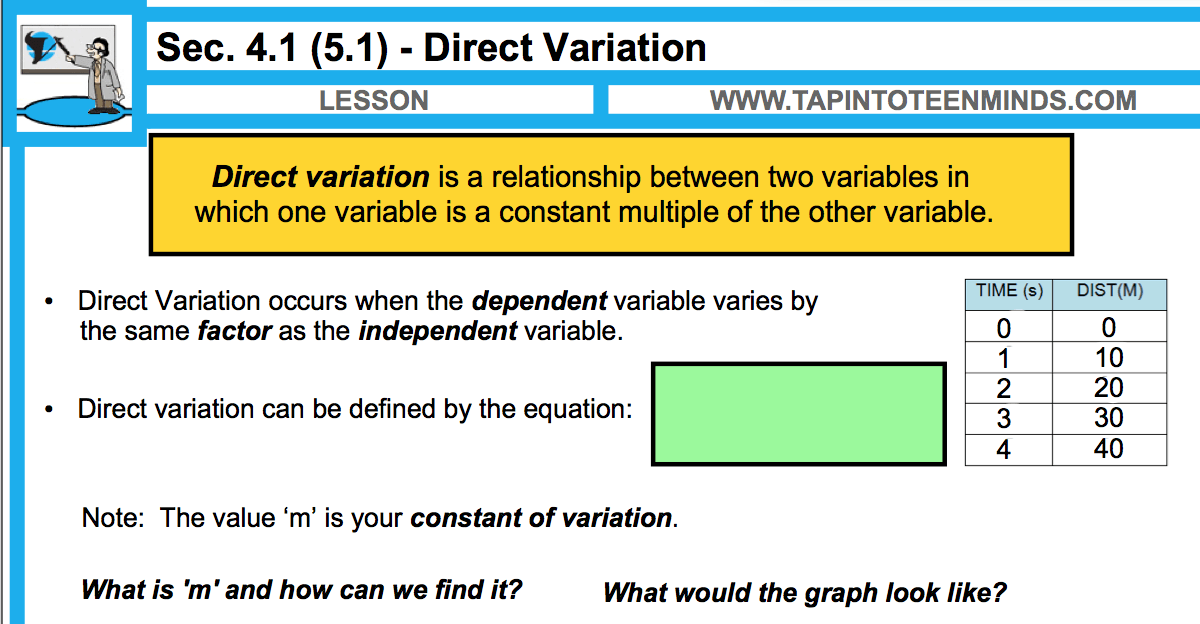
Sec. 4.1 – Direct Variation

Investigation: Going for a Jog
Video discussing the mind buster problem from our section on Direct Variation:

Identify the independent/dependent variables.

Describe the shape of the graph.
Where does it intersect the vertical axis?

Write an equation to find the distance, 
d, in metres, that Susan jogs in t mins.

Use the equation to determine the 
distance that Susan can jog in 25 mins.

Consider the distance Susan jogged in 5 minutes.
What happens to this distance when the time is doubled?
What happens to the distance when the time is tripled?


What Is Direct Variation?

A Direct Variation is a relationship between two variables in which one variable is a constant multiple of the other variable.

A video discussing the following related to Direct Variation:

  • How we can relate direct variation to proportional reasoning,
  • what a direct variation looks like in a table and graph, and
  • how to find the constant of variation, m.


From Homework – Page 242-244 #6

In the following video, Mr. Pearce and the class discuss a question from the homework. This was recorded the next day at the beginning of class with the help of the students. The question asks:

The cost of oranges varies directly with the total mass bought. 2 kg of oranges costs $4.50.

a) Describe the relationship in words.
b) Write an equation relating the cost and the mass of the oranges. What does the constant of variation represent?
c) What is the cost of 30 kg of oranges?


Sec. 4.2 – Partial Variation

What Is Partial Variation?

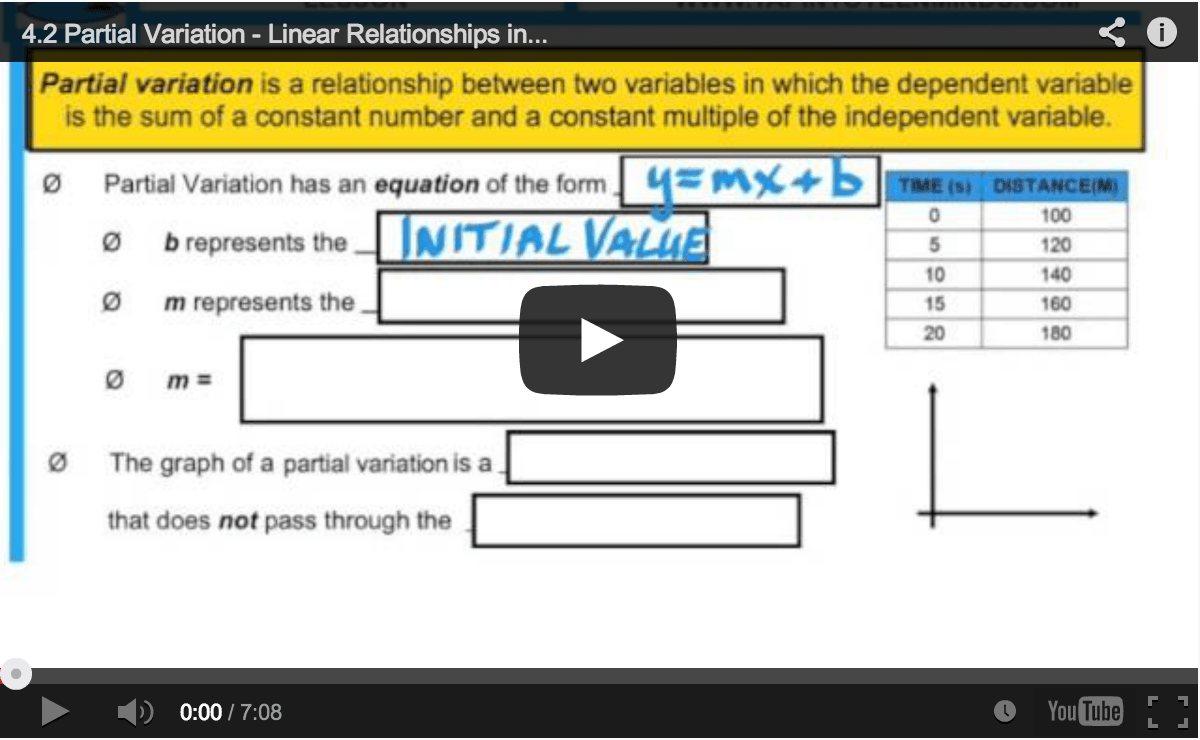
A Partial Variation is a relationship between two variables in which the dependent variable is the sum of a constant number and a constant multiple of the independent variable.

A video discussing the following related to Partial Variation:

  • What a partial variation looks like in a table,
  • what a partial variation looks like in a graph,
  • what a partial variation looks like in an equation, y = mx + b and
  • how to find the constant of variation, m.


Sec. 4.2.R – Direct and Partial Variation

This video was recorded at the beginning of class. Mr. Pearce and the class take up a question from the previous day to summarize Partial Variation and discuss why the relationships involved in the question are Partial and not Direct variation. The question is:

A theatre company produced the musical Cats. The company had to pay a royalty fee of $1250 plus $325 per performance. The same theatre company also presented the musical production of Fame in the same year. For the production of Fame, they had to pay a royalty fee of $1400 plus $250 per performance.

  • Write an equation that relates the total royalties and the number of performances for each musical.
  • Graph the two relations on the same grid.
  • When does the company pay the same royalty fee for the two productions? (Break Even Point)
  • Why do you think the creators of these musicals would set royalties in the form of a partial variation instead of a direct variation?


Sec. 4.3 – How to Find Slope of a Line Using Rise Over Run

This video was recorded during a lesson. Students were asked to work with their table groups to answer the following:

4.3 How to Find Slope of a Line Using Rise Over Run

Consider the graph of line segment AB to the right.

  • Is the slope positive or negative? Explain.
  • Determine the rise and run by counting grid units.
  • Determine the slope of the line segment AB.


Sec. 4.3 – How to Find Slope of a Line Using Rise Over Run

This video shows students how to find the slope of a slide as well as the slope of a roof.


Sec. 4.3 – Draw a Line Given Slope and One Point

This video recaps the Mind Buster portion of our Sec. 4.3 (5.3) Slope (Part 2) lesson where:

A line segment has one endpoint, A(4, 5) and a slope of -2/3.

Can you find the coordinates of 2 other points on the line?


Sec. 4.4 – Slope as a Rate of Change – Interpreting Slope of a Line

This video focuses on Slope as a Rate of Change for a linear system of equations. In this case, the question is as follows:

The distance-time graph shows two cars that are travelling at the same time.

  • Which car has the greater speed, and by how much?
  • What does the point of intersection of the two lines represent?


Sec. 4.5 – Identifying Linear & Non-Linear Relationships with First Differences

This video demonstrates How First Differences in a Table of Values Can Identify Linearity of a Relationship by comparing two relationships from a table of values. The question from the video asks:

Each table shows the speed of a skydiver before the parachute opens. Without graphing, determine whether the relation is linear or non-linear.

  • Case when there is no air resistance, and
  • Case when there is air resistance.


Sec. 4.7 – Connecting Variation, Slope and First Differences of Linear Relations

Today, students had a discussion about the four representations of a linear relationship; a description, table, graph and equation. From this, students took a table to determine the type of variation, the slope/rate of change/constant of variation, initial value and a description to match. They then created an equation in y = mx + b form to summarize their understanding.

Take the following table of values and create the following representations to match:

  • A Description,
  • A Graph, and
  • An Equation.


MPM1D – 4.1 – Direct Variation

MPM1D – Principles of Mathematics – Grade 9 Math Academic

Expectations Covered This Section:

  • construct tables of values, graphs, and equations, using a variety of tools (e.g., graphing calculators, spreadsheets, graphing software, paper and pencil), to represent linear relations derived from descriptions of realistic situations;
  • compare the properties of direct variation and partial variation in applications, and identify the initial value (e.g., for a relation described in words, or represented as a graph or an equation);

Minds On

Investigation: Going for a Jog

4.1 - Direct Variation - Linear Equations MPM1D Math

Students will work in their table groups to create a table of values and graph the relationship on a grid. They will then complete the following related to the problem:

Identify the independent/dependent variables.

Describe the shape of the graph.
Where does it intersect the vertical axis?

Write an equation to find the distance, 
d, in metres, that Susan jogs in t mins.

Use the equation to determine the 
distance that Susan can jog in 25 mins.

Consider the distance Susan jogged in 5 minutes.
What happens to this distance when the time is doubled?
What happens to the distance when the time is tripled?

The class will engage in a discussion using Apple TV as a means to quickly display different student work from across each table group.

Minds on Solutions


Action

Unit 4 Modelling With Graphs – 4.1 – Direct Variation

4.1 - What is a Direct Variation Linear Equation? MPM1D Math

The teacher will lead a discussion about direct variation and attempt to demystify the definition:

A Direct Variation is a relationship between two variables in which one variable is a constant multiple of the other variable.

The discussion will cover the following direct variation topics:

  • How we can relate direct variation to proportional reasoning,
  • what a direct variation looks like in a table and graph, and
  • how to find the constant of variation, m.

What is Direct Variation Video

A video encapsulating most of the topics covered in our classroom discussion about Direct Variation.

Direct Variation Task Questions

The teacher will scaffold the students through the lesson using a gradual release of responsibility approach. The teacher will begin the first two tasks with the students and then let groups solve the problems in the way they feel most comfortable.

The direct variation task questions target the students’ ability to identify a direct variation in a word problem, from an equation, table and graph.

Tasks can be shared out via Apple TV to show multiple methods of solving each task question.


Consolidate

Identifying Direct Variation and Determining the Constant of Variation

4.1 - Identifying Direct Variation and Determining the Constant of Variation

Students will answer the consolidation questions that indicate whether students can identify a direct variation in the form of an equation, table and a graph as well as whether they can determine the constant of variation when a linear equation is a direct variation.

Submit Consolidation Answers in the Google Drive Form

When complete, students will submit their consolidation answers in the Google Drive Form below:


YouTube Videos

MPM1D – 4.1 – Direct Variation

All Unit 4 Videos can be found on the Math Videos – Unit 4 Modelling With Graphs page.
 

See All Unit 4 Math Videos Here

 
Videos recorded before, during or after class will be listed below:

Questions From Homework:

In the following video, Mr. Pearce and the class discuss a question from the homework. This was recorded the next day at the beginning of class with the help of the students. The question asked is:

The cost of oranges varies directly with the total mass bought. 2 kg of oranges costs $4.50.

a) Describe the relationship in words.
b) Write an equation relating the cost and the mass of the oranges. What does the constant of variation represent?
c) What is the cost of 30 kg of oranges?


Worksheets & Resources

MPM1D – 4.1 – Direct Variation

DOWNLOAD BLANK WORKSHEET (PDF)
Math Worksheet and Resource Handouts
DOWNLOAD WORKSHEET SOLUTIONS (PDF)
Math Worksheet and Resource Handout Solutions

Math Videos – MPM1D Unit 3 Solving Equations

MPM1D – Principles of Mathematics – Grade 9 Academic

Sec. 3.1 – Solving Simple Equations – One and Two Step Equations

Learn how to solve a simple equation involving two-steps:

Solve:

4m – 6 = 12


Sec. 3.2 – Solve Two-Step Equations

Learn how to solve a two-step equation:

Solve:

7x – 4 = 10


Sec. 3.2 – How to Solve Multi-Step Equations Involving Like Terms

Solve:

3 + 4m + 5m = 21


Sec. 3.2 – How to Solve Multi-Step Equations With Variable Terms on Both Sides

Solve:

4y – 13 = -6y + 7


Sec. 3.2 – How to Solve Equations Involving Distributive Property

Solve:

4(k – 3) = 2 – (2k – 6)


Sec. 3.3 – How to Solve Equations with One Fraction

Solve:

(1/3)(x – 2) = 5

and

16 = [3(v + 7)]/2


Sec. 3.3 – How to Solve Equations with One Fraction and Distribution

Solve:

[3(z - 5)]/4 = 7


Sec. 3.3 – How to Solve Equations with One Fraction and Distribution (Part 2)

Solve:

3 = [2(n + 7)]/5


Sec. 3.3 – Solving Equations with One Fraction Application Questions

A trapezoidal backyard has an area of 100 m^2. The front and back widths are 8 m and 12 m, as shown in the diagram.

What is the length of the yard from front to back?


Sec. 3.4 – Modelling and Rearranging Formulas

Rearrange the following equation for ‘h’

V = p(r^2)h


Sec. 3.6.R – Create and Solve Equations from Word Problems

The sum of two consecutive even integers is -134. Find the numbers.


Sec. 3.6.R – Problem Solving Using Equations

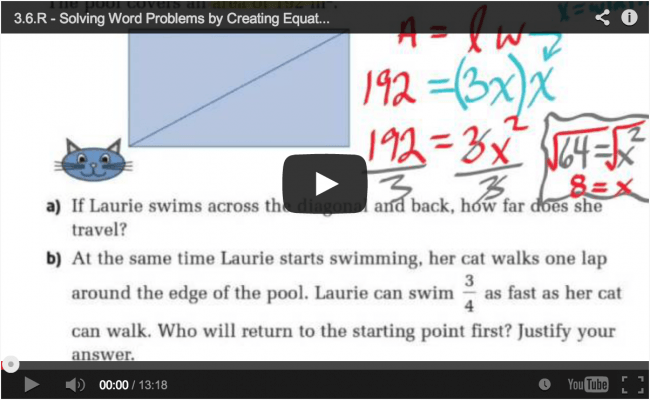
The length of Laurie’s rectangular swimming pool is triple its width. The pool covers an area of 192 m^2.

If Laurie swims across the diagonal and back, how far does she travel?

MPM1D – 3.6.R – Unit 3 Solving Equations Review

MPM1D – Principles of Mathematics – Grade 9 Math Academic

Expectations Covered This Unit:

  • simplify numerical expressions involving integers and rational numbers, with and without the use of technology;
  • add and subtract polynomials with up to two variables [e.g., (2x – 5) + (3x + 1), (3x2y + 2xy2) + (4x2y – 6xy2)], using a variety of tools (e.g., algebra tiles, computer algebra systems, paper and pencil);
  • multiply a polynomial by a monomial involving the same variable [e.g., 2x(x + 4), 2x2(3x2 – 2x + 1)], using a variety of tools (e.g., algebra tiles, diagrams, computer algebra systems, paper and pencil);
  • expand and simplify polynomial expressions involving one variable [e.g., 2x(4x + 1) – 3x(x + 2)], using a variety of tools (e.g., algebra tiles, computer algebra systems, paper and pencil);
  • solve first-degree equations, including equations with fractional coefficients, using a variety of tools (e.g., computer algebra systems, paper and pencil) and strategies (e.g., the balance analogy, algebraic strategies);
  • rearrange formulas involving variables in the first degree, with and without substitution (e.g., in analytic geometry, in measurement);
  • solve problems that can be modelled with first-degree equations, and compare algebraic methods to other solution methods.

Problems With Homework Form

Students will complete the Problems With Homework Form to indicate any problems they had with the work from the previous day as well as to self-assess where they are in terms of their own learning in the course.


Minds On

Recap and Recall Work From Previous Day

Students will have an opportunity to look at a couple questions from the previous day. Mr. Pearce will record his iPad screen and then post to YouTube after class for student reference.

Write and Solve an Equation in at Least Two Ways

MPM1D 3.6.R Unit 3 Review - Solving Equations

Students will work in their table groups to write an equation and solve the equation that could correspond to the following problem:

The number of hours that were left in the day was one-third of the number of hours already passed.

How many hours were left in the day?

Students are instructed to answer the question in at least two ways.

Table groups will share-out via Apple TV to allow students the opportunity to view other ways to solve the problem.


Action

Unit 3 Review – Solving Equations

MPM1D 3.6.R Unit 3 Reivew - Solving Equations Handout Resources
Students will continue working collaboratively in their table groups to solve Unit 3 Review – Solving Equations questions.

Each group will be responsible for sharing solutions periodically throughout the duration of the class.


Consolidate

Unit 3 Review Problems

MPM1D 3.6.R Solving Equations Consolidation

Students will consolidate their learning acquired during this lesson as well as throughout the unit by selecting questions from the digital textbook that target problem areas for each student.

Mr. Pearce will display possible consolidation questions over the Apple TV and he will ask students to rank the questions on a scale from 1 to 10, where 1 is easy and 10 is difficult. Students are then suggested to avoid spending too much time on questions that they find “easy” and focus on questions they find moderately to very difficult to ensure they maximize their time spent on math in preparation for the Unit Test next day.


YouTube Videos

MPM1D – 3.6.R – Solving Equations

All Unit 3 Videos can be found on the Math Videos – Unit 3 Solving Equations page.
 

See All Unit 3 Math Videos Here

 
Here are the two problems we solved at the beginning of class from your last day’s homework…

Video #1: Using Equations to Solve Word Problems

Mr. Pearce and students during class solved #10 from the previous day’s homework:

The sum of two consecutive even integers is -134. Find the Numbers.

Video #2: Using Equations to Solve Word Problems

The length of Laurie’s rectangular swimming pool is triple its width. The pool covers an area of 192 m^2.

If Laurie swims across the diagonal and back, how far does she travel?


Worksheets & Resources

MPM1D – 3.6.R – Solving Equations

DOWNLOAD BLANK WORKSHEET (PDF)
MPM1D 3.6.R Solving Equations Handout
DOWNLOAD WORKSHEET SOLUTIONS (PDF)
MPM1D 3.6.R Solving Equations Handout Solutions